From Bronze to Gold: A Medallion Guide to Software in the Age of Infinite Code

From Bronze to Gold: A Medallion Guide to Software in the Age of Infinite Code
These blog posts are intended to provide software tips, concepts, and tools geared towards helping you achieve your goals. Views expressed in the content belong to the content creators and not the organization, its affiliates, or employees. If you have any questions or suggestions for blog posts, please don’t hesitate to reach out!
Introduction
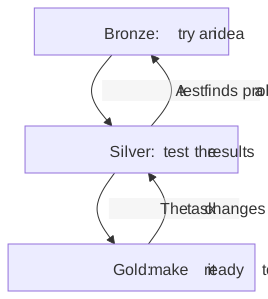
Code moves forward as we find evidence that it works for the task. A problem can send us back.
Bronze is a first attempt. Silver has evidence behind it. Gold is ready for a clear use. These levels give us a way to discuss research software without treating every piece of code as finished work. We borrow them from medallion architecture, which organizes data through stages of refinement. Here, step zero plus ten questions help us apply the same idea to software.
The move from small data to big data offers a useful parallel. A table you can inspect row by row calls for different checks than a collection too large to review by hand. We can think of AI-assisted work as a move from small code to big code. We may have more code and more possible versions than we can inspect at once. That makes selection, testing, and removal part of the task, not work to leave until later. More code is not the goal. A result we can trust is.
In data work, the medallion architecture helps us move from raw records to tested data and then to data prepared for use. Here, we adapt that pattern to software: try an idea, test its results, and prepare it for others. Step zero and these ten questions are our proposed guide, not a validated standard for software quality. The medals describe the evolution of the code as it is clarified to realized value.
Babel: More Code Does Not Mean Better Answers
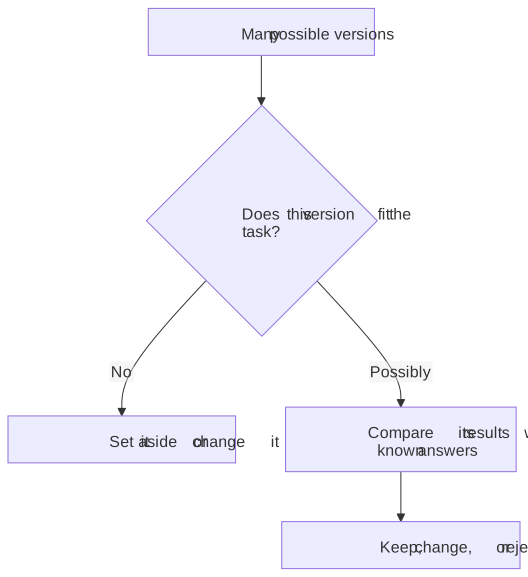
A clear task helps us choose what to test. Known answers help us judge the result.
Jorge Luis Borges imagines an unusual library in The Library of Babel. It contains every possible book within a fixed set of rules. Most books contain gibberish. Meaningful books sit among countless false or slightly wrong versions. Its readers still need a way to recognize the right answers.
Generative tools give code work a similar shape. A team can hold many versions of the same solution at once. Most of them will be wrong in ways that are not obvious at a glance. We might call this moment the age of infinite code: the shelves are full, but the right answer does not stand out on its own.
Before an answer can mislead us, we have to find it at all. The gibberish buries it, and every hour of sifting is an hour not spent checking. One check asks whether the code does what we planned. Another asks whether the plan answers the right question. The search rewards patience, but only the checks reward trust.
A believable answer is not always a correct answer.
A clear task and tests with known answers help us tell the two apart. The medallion levels below turn that need into questions we can ask as the work moves forward.
Medallion Guide to Software at a Glance
| Level | Question | What you need |
|---|---|---|
| 🪵 Wooden | 0. Is there an idea worth a first try? | A rough sketch or code fragment. Expect gaps and errors. Do not rely on its results. |
| 🥉 Bronze | 1. What is the job? | A clear task and its limits. |
| 🥉 Bronze | 2. What goes in and comes out? | A description of the data the code takes and returns. |
| 🥉 Bronze | 3. Can a small example run safely? | A first attempt that leaves the original data untouched. |
| 🥈 Silver | 4. Does it give a known answer? | An expected result worked out separately from the code. |
| 🥈 Silver | 5. What happens with difficult data? | Tests for missing values, unusual inputs, and rules that must hold. |
| 🥈 Silver | 6. Does the code follow the plan? | A review of the code against the intended method. |
| 🥈 Silver | 7. Does it work on real examples? | A small trial with realistic data and clear limits. |
| 🥇 Gold | 8. Can someone run it again? | Saved data references, software versions, and instructions. |
| 🥇 Gold | 9. Can someone understand and use it? | A guide that explains the method, its limits, and who to contact. |
| 🥇 Gold | 10. Do we know which version to use? | A named version tied to its test results. |
Wooden: Sketch an Idea
Wooden is a sketch to discuss, not a result to trust.
Wooden is step zero: it comes before the ten questions begin. It is an addition to this guide, not a layer in the original medallion architecture. It might be a rough idea, a few lines of code, or a fragment an AI tool drafted. The point of wooden is to give the team something to talk about. We do not rely on its results, and we do not share it as a tool. A wooden sketch becomes bronze when the team agrees the idea is worth a first real try.
Bronze: Try an Idea
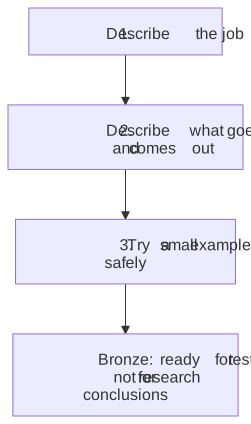
Bronze gives us a first attempt and a clear reason to test it.
In medallion architecture, bronze holds raw data before later work improves it. For our code, bronze means a first attempt whose quality we do not yet know. A person can write it, an AI tool can draft it, or we can adapt existing code. We judge the code by what it does, not where it came from. In our class, the teacher guides the first shared attempt.
1. Describe the job. Write down the task before you ask for code. For our example: “Adjust each cell measurement against control wells from the same plate. Do not use treated wells to set the reference.” This gives us something clearer than “adjust the data.” Code that does a different job is not ready to move forward, even if it runs.
2. Describe what goes in and comes out. List the columns the code needs and what it must return. Name the columns that identify the cells, plates, and control wells. Describe what happens to missing values and which labels must stay unchanged. Keep unresolved questions in the written plan rather than letting the code choose an answer without your knowledge.
3. Try a small example safely. Use a copy of a tiny table. Make sure that the code accepts it and returns something you can read. Keep the original data untouched. Do not give unreviewed code access to passwords or private data. A successful run means you have something to test. It does not mean the method is correct.
Bronze needs a useful first attempt, not a finished product.
Silver: Test the Results
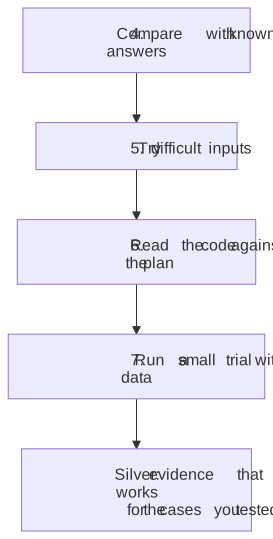
Silver tests whether the code does the right job, not merely whether it runs.
In medallion architecture, silver holds data after cleaning and testing. For our code, this level asks whether the results match the method we intended. Wilson and colleagues’ Best Practices for Scientific Computing recommends automated tests and code review for scientific software. All four questions matter. In our class, the teacher helps students test whether the pieces fit. For code, tests and review serve that role.
4. Compare with known answers. Choose a few values whose expected results you can work out separately. Compare the code results with those answers. For decimal calculations, state how much difference you will allow and why. An AI tool can help write tests, but tests can repeat the same mistake as the code. Do not treat the output of the code itself as the expected answer.
5. Try difficult inputs. Try a plate with no control wells, a column of identical values, or missing measurements. Decide whether each case needs an error, a warning, or a defined result. Also test rules that must always hold. For example, a different row order must not change the result for a cell. Each measurement must stay linked to the correct cell label.
6. Read the code against the plan. Make sure that the code uses only the intended control wells as its reference. Look at how it separates plates and whether it removes or changes any values. Remove extra steps that make the method hard to follow. Another reviewer can help, but agreement alone is not proof. Several reviewers can share the same wrong assumption.
7. Run a small trial with real data. Choose a small set that includes the differences and problems you expect in practice. If you have a trusted method, compare the results with it. Explain any differences. Make sure that the code fits your time and memory limits. Save what you tested, what counted as success, and which cases you did not cover.
A successful trial supports the cases you tested, not every future use. If the results reveal a problem, change the code or the plan and test again.
Gold: Make It Ready to Use
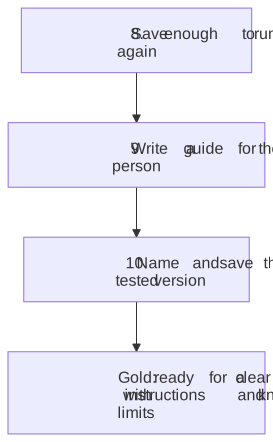
Gold means ready for a clear use. It does not mean perfect.
In medallion architecture, gold holds data prepared for a particular use. For our code, this level helps the next person use the tested version responsibly. A notebook for one study needs less support than a tool that many teams share. Both need clear instructions and limits. In our class, this means preparing the shared piece for use and explaining how to care for it.
8. Save enough to run it again. Record the code version, other software it needs, input data, and values that control the run. Save the test results. If the method uses randomness, record its starting value, often called a random seed. Follow the instructions on a fresh setup to make sure that they work. State any machine or calculation differences that can change the results. This follows Sandve and colleagues’ Ten Simple Rules for Reproducible Computational Research. Their guidance includes recording how each result was produced, exact software versions, and random seeds.
9. Write a guide for the next person. Explain the method, the required control wells, and the data the code expects. Describe warnings and known problems. Name the person or team responsible for the software. Provide a way to report errors. State whether anyone will update the code or whether it stays as a record of a finished analysis.
10. Name and save the tested version. Give the code a version name, such as a release number. Include a license that states how others can use it. Keep its test results with that version. Make sure that the version you share is the one you tested. For published data, record which code version produced it. Used this way, code almost acts as metadata: information about the data. Alongside the saved settings, it describes how the inputs became the outputs. Peter Naur’s essay Programming as Theory Building argues that a program is a theory held by the people who build it, and the code text records only part of that theory. When those builders leave, the text remains, and the theory can fade with them. The saved plan, tests, and guides cannot hold the whole theory, but they give the next person evidence to rebuild it from. Naur treats the theory as something a team builds and holds together, not a private idea in one head. A program stays alive while the people holding its theory remain in charge of its changes. Within a living team the theory is uneven, and each departure takes part of it. The bundle cannot hold the whole theory, but it keeps the team’s shared awareness of it from shrinking to a single head.
If the method, required software, or intended data changes, return to the relevant tests. A new version does not inherit trust from its name. Not every idea needs to reach gold, but research conclusions need more support than an untested first attempt. For work where errors can cause serious harm, this guide is only a starting point.
Guide the Work from Bronze to Gold
The medallion levels help us decide what the shared work needs next. In our ceramics class, the teacher moves between workbenches, looks at each contribution, and helps the students bring the pieces together.
Problems give these conversations direction. A failed test can reveal a missing rule or a mistake that several contributors share. Treat that discovery as progress toward a better result, rather than pressure to hide the problem. Accept that mistakes happen, then use the evidence to guide the next revision. This is part of research decision engineering: deciding where to direct effort and how to judge the result.
As the work improves, the next useful change can be a removal. An unused feature or a repeated step can make the code harder to understand without helping the task. Remove that extra weight, but keep the tests, safety measures, and evidence that support trust. A shorter program is not better if it loses something the work needs. The focus on removal echoes Saint-Exupéry’s discussion of design in Wind, Sand and Stars.
So when do we know we are finished, for now? When the shared result does the agreed job, the tests support it, and someone else can use it within its stated limits. We know the work is done when nothing is left to remove without losing something the task needs. That assumes the work passes its checks and has no known problem that defeats its purpose. New evidence or a changed task can bring us back to the workbench. Until then, we can save the tested version and let it do its job.